.png)

If your boiler is ageing or you are planning an upgrade, choosing between a modern boiler and an air source heat pump can feel like a big decision. The right answer often depends more on your home and lifestyle than on headlines, especially in mixed areas such as Leeds and the wider West Yorkshire region.
Both boilers and heat pumps move heat into your home, but they work very differently. Understanding the basics makes it much easier to see which suits your property.
A gas boiler burns fuel to create high-temperature water, typically flowing around your radiators at 60 to 75°C. This suits older radiators and homes that were never designed with efficiency in mind.
An air source heat pump works more like a fridge in reverse. It takes low-temperature heat from the outside air and upgrades it using electricity, usually running at flow temperatures of 35 to 50°C. It gives steadier, background warmth rather than sharp bursts of heat.
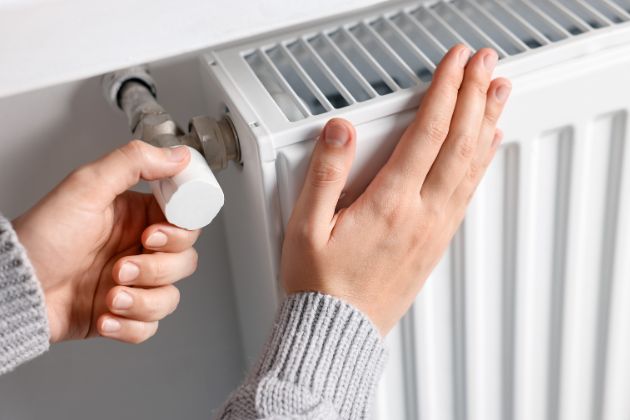
With a boiler, you tend to heat the house in shorter bursts. Radiators get very hot, cool down, then heat up again when the boiler fires. Some people like the radiators feeling very warm to the touch, but room temperatures can fluctuate.
Heat pumps work best when they run for longer at lower temperatures. Radiators or underfloor loops feel warm rather than hot, and rooms stay at a more even temperature throughout the day. It is a different style of comfort: less dramatic, more consistent.
Modern condensing boilers are very efficient when return water temperatures are low, but in typical settings their real-world efficiency often sits around 85 to 90%. They are less sensitive to insulation standards, although poor insulation still wastes energy.
Heat pumps can deliver 2.5 to 4 units of heat for every unit of electricity, but they only achieve this when they are carefully designed and running at lower flow temperatures. That is where insulation and radiator sizing really matter.
In a well-insulated home, a heat pump can quietly maintain temperature with low flow temperatures, which keeps efficiency high. In a draughty house with small radiators, the system may need higher temperatures that reduce performance and comfort.
One of the biggest practical questions is what happens to your existing heating system indoors. A boiler will usually work with what you already have, often with minimal changes beyond a cleanse of the pipework and maybe a new control system.
Heat pumps need enough radiator surface area to deliver heat at lower water temperatures. That may mean upsizing some radiators, adding more, or combining radiators upstairs with underfloor heating downstairs.
Combi boilers provide hot water on demand, so no cylinder is needed. For larger homes or multiple bathrooms, system boilers with an unvented cylinder are often a better fit.
Most air source heat pumps work with a hot water cylinder. They usually heat the cylinder to a slightly lower temperature than a boiler, then use an immersion heater for periodic pasteurisation. If space is tight, finding room for a cylinder can be a key design step.
Boilers live indoors, usually in a kitchen or utility room, with a flue to the outside. Properly installed and serviced, modern models are quiet in day-to-day use.
A heat pump has an outdoor unit with a fan and compressor, which will make some noise when running. Good engineers select the right location, consider neighbours and windows, and use anti-vibration mounts to keep this to an acceptable level.
The unit needs clear airflow, drainage for condensate and safe access for servicing. A professional survey looks at these points carefully before any design is finalised.
Both systems benefit from regular attention. A boiler should be serviced annually to check combustion, safety devices and water quality. This helps maintain efficiency and protects your warranty.
Heat pumps also need regular checks, typically once a year. An engineer will inspect electrical connections, refrigerant circuit, filters, pumps and controls, and confirm the system is still delivering the design performance.
In everyday use, both can be mostly “set and forget” with a good control strategy. Heat pumps in particular respond well to consistent settings rather than frequent manual adjustments.
Use this quick checklist to frame a discussion with an engineer, rather than to make a final decision on your own.
If your semi is reasonably modern or has been well insulated, a heat pump can work very well. With slightly larger radiators or underfloor heating downstairs, you can enjoy steady, efficient comfort.
A modern boiler is still an option if you prefer a more traditional setup or cannot accommodate an outdoor unit. In many cases, both routes are technically viable, so detailed design and your long-term plans will guide the choice.
In an older terrace with solid walls and single glazing, jumping straight to a heat pump without fabric improvements can be disappointing. Heat loss will be high, and radiators may need significant upgrading.
A staged approach can work well: first tackle insulation, draught-proofing and windows, then review heating options. A new boiler might be a bridging step, with pipework laid out so a future heat pump swap is easier.
If several showers, baths and appliances often run at the same time, good hot water design is critical. A system boiler with a generous unvented cylinder is a familiar solution that copes well with peaks in demand.
A heat pump can also serve high hot water loads, but it relies on a correctly sized cylinder and smart control of recovery times. Space for the cylinder and pipework routing become important design details.
In a small property with limited outdoor space and no room for a cylinder, a compact boiler is often the simplest answer. The flue can usually be routed neatly, and existing radiators can stay.
Some flats and small homes can still suit a heat pump, especially in well-insulated blocks, but this usually needs building-wide planning rather than a purely individual decision.
Modern air source heat pumps are designed to work in typical UK winter conditions. Their output does drop slightly in very cold snaps, but a correctly sized system accounts for local design temperatures.
Engineering the system for realistic winter conditions, with the right emitters and controls, is far more important than occasional claims about low outdoor temperatures.
Not always. Many homes only need some radiators upsizing, often in the larger or colder rooms.
A proper heat loss calculation by an engineer will show which rooms are fine, which radiators need changing and whether any underfloor heating would be beneficial.
Heat pumps can significantly reduce carbon emissions, especially as the electricity grid becomes greener. However, their real benefit depends on correct design, installation and insulation levels.
A badly set up system running at very high temperatures may not perform much better than a good boiler, which is why professional design and commissioning are so important.
Choosing between a boiler and a heat pump is best treated as an engineering decision based on your home, not a guess. A detailed survey, heat loss calculation and discussion about how you actually live in the property will give you a clear route forward, whether you are in Leeds, elsewhere in West Yorkshire or beyond.
For tailored advice and a professional home assessment, contact S.P Contractors Limited on 07802742177. To explore your options in more depth, you can visit our heat pump installation page or our boiler installation page for practical next steps.
.svg)


.jpg)


