.png)
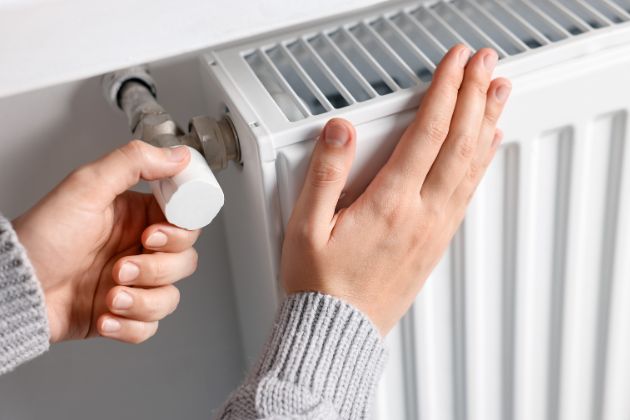
If your radiator feels hot at the top but stays cold at the bottom, it usually means there’s a problem with how water is flowing through your heating system. This is a common issue that often points to blockages or trapped air inside the radiator. The good news is that many of the causes are straightforward and easy to identify. Some simple checks and fixes can be done safely by homeowners, helping you save time and avoid unnecessary call-outs. However, knowing when to call a professional is important to keep your heating running efficiently and reliably.
A radiator that only heats at the top almost always points to a flow problem inside the radiator or in the pipework feeding it. Heat rises, so the hottest water tends to sit at the top while cooler water stays at the bottom if circulation is poor.
Several issues can cause this, but most will fall into one of three groups: sludge and dirty water, valve position problems, or wider circulation issues in the system.
Over time, metal components in your heating system can corrode slightly and create tiny rust particles. These mix with limescale and other debris to form a thick sludge that settles in the lowest parts of your radiators.
When enough sludge collects at the bottom, hot water can no longer move freely through the whole radiator. The top gets hot where water can still flow, but the bottom stays cold or only lukewarm.
Trapped air usually collects at the top of a radiator, not the bottom. So if the top is cold and the bottom is hot, air is the main suspect and bleeding the radiator often helps.
With a radiator that is hot at the top and cold at the bottom, trapped air is much less likely. In this case, you are usually dealing with sludge, a flow restriction, or a valve problem rather than air.
Your radiator will normally have two valves: a control valve or TRV (thermostatic radiator valve) on one side, and a lockshield valve on the other. If either of these is stuck or only partially open, water may not flow properly through the radiator.
A partially closed valve can mimic the symptoms of sludge, because hot water cannot travel all the way through the radiator. The top may get a bit of warmth, but the bottom remains noticeably cooler.
If several radiators in your home, especially the ones furthest from the boiler, are cold at the bottom, your circulation pump or the overall system balance could be struggling. The pump might be set too low, starting to fail, or your system may simply need rebalancing.
This is more than a local radiator problem and is usually a job for a qualified heating engineer, particularly if you also notice noisy pipework or radiators taking a long time to heat up.
Before you reach for the toolbox, always ensure your boiler and heating system are safe to work on. Never open the boiler casing or touch electrical components. The following checks stay on the outside and are generally safe for confident homeowners.
First, make sure your heating is on and has been running for at least 20 to 30 minutes. Then feel the radiator carefully from top to bottom, watching for temperature changes.
Check the TRV side: if it has numbers on it, set it to the highest number. On the lockshield side, gently remove the plastic cap if fitted and use a small adjustable spanner to turn the valve a quarter turn anticlockwise to ensure it is not fully closed. Do not force it; if it will not move, stop and call an engineer.
If a radiator is cold at the top and warm at the bottom, trapped air is likely. In that case, bleeding may help. If the top is already hot, bleeding rarely fixes a cold bottom.
To bleed safely: turn the heating off and let the system cool slightly. Place a cloth and container under the bleed valve, use a radiator key to turn it slowly anti clockwise until air hisses out, then close it as soon as water runs in a steady stream.
With the heating back on, carefully feel the flow and return pipes to the radiator. One side should be hotter, but both should warm up reasonably once the system has been running.
If one pipe is very hot and the other is almost cold, water is not flowing properly through the radiator. This often points to sludge inside the radiator or a restriction in one of the valves rather than a simple airlock.
Some symptoms are clear signs that a professional heating engineer should take over. Continuing to run the system without help can sometimes make problems worse.
Call an engineer if you notice any of the following:
At this point, work such as power flushing, pump replacement, system balancing, or internal boiler checks should only be carried out by a Gas Safe registered engineer.
Once your radiators are working properly again, a little ongoing care can help prevent the same problem returning. Good water quality is key to avoiding sludge build up and poor circulation.
A heating engineer may recommend adding system inhibitor to reduce corrosion, fitting a magnetic filter to catch metal particles, and having regular boiler and system servicing. These measures help keep pipework and radiators clear, improve efficiency, and extend the life of your heating system.
In most cases, a radiator that is cold at the bottom is not immediately dangerous, but it does mean your system is not working efficiently. You are burning fuel without getting the full benefit of the heat.
However, if this is combined with noises, pressure changes, or boiler faults, it can be a sign of a more serious issue and should be checked by a professional as soon as possible.
Yes, a badly sludged or restricted radiator can affect the overall flow in your system. It can make the boiler and pump work harder and may contribute to uneven heating in other rooms.
In larger homes around Leeds, Harrogate, Wakefield, Wetherby and nearby areas, a number of poorly working radiators together can significantly reduce comfort and efficiency across the whole property.
Bleeding only helps when air is trapped at the top of the radiator, which gives a cold top and hot bottom. If your radiator is hot at the top and cold at the bottom, bleeding alone is very unlikely to solve it.
In that situation, the real fix is normally dealing with sludge, valve issues, or circulation problems. These often require specialist tools and knowledge, so it is sensible to involve a heating engineer.
If your radiators are cold at the bottom, or your heating just is not performing as it should, a professional boiler and system health check can save you a lot of frustration. An engineer can test circulation, clean out sludge, balance your radiators, and make sure your boiler is running safely and efficiently.
Homeowners in Leeds, Harrogate, Wakefield, Wetherby and surrounding areas can book a thorough boiler service and repair visit with SP CONTRACTORS LIMITED. To arrange a boiler and system health check, or to talk through issues with cold radiators, call 07802742177 or visit our boiler servicing and repair page to book your appointment.
.svg)


.jpg)


