.png)
.jpg)
If your boiler has started making banging, kettling, or gurgling noises, it can be both worrying and annoying. These sounds are quite common in many homes, but they should never be ignored. Noisy boilers often signal an underlying problem that needs fixing to avoid more serious damage or costly repairs. Addressing these noises early can help keep your heating running smoothly, improve efficiency, and ensure your home stays warm and safe.
Not every strange noise means your boiler is unsafe, but it is a clear sign something is not working as it should. Left alone, the issue can get worse, reduce efficiency and shorten the life of your boiler.
If the boiler is loudly banging, clunking or vibrating, switch it off at the boiler control and at the mains power. Do not try to take the boiler apart. For anything more than simple checks, you should call a qualified Gas Safe registered engineer.
There are a few clear danger signs where you should act immediately and treat it as an emergency rather than a routine repair.
Noisy boilers usually fall into a few main categories. Understanding these helps you explain the problem clearly to an engineer and, in some cases, carry out simple checks yourself.
Kettling is the term for a boiler that sounds like a kettle boiling, with rumbling and banging as water heats up. It is often caused by limescale or sludge building up on the heat exchanger, restricting water flow and creating hot spots.
As water boils and turns to steam in those hot spots, it expands suddenly and creates banging, knocking and rumbling. This is common in hard water areas and on older systems that have not been flushed or treated for a long time.
Kettling needs attention from a professional. They may recommend a chemical flush, powerflush, system filter, scale reducer or, in some cases, a new heat exchanger or even a replacement boiler.
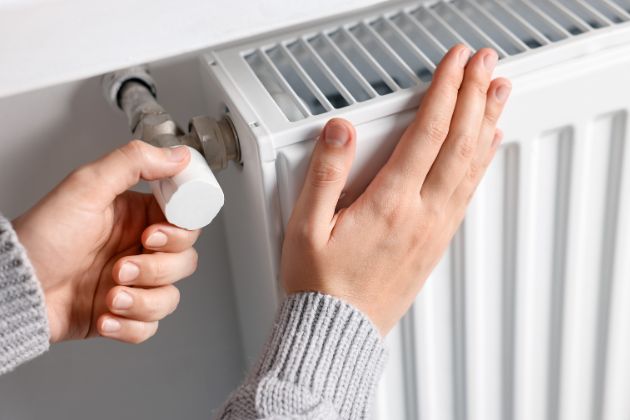
Gurgling or light knocking in pipes and radiators is often trapped air. This can happen after work on the system, topping up pressure, or simply over time as tiny air bubbles collect.
Trapped air can reduce heating performance and put extra strain on your boiler. Thankfully, this is one of the few issues you can often improve yourself by bleeding the radiators carefully.
Your boiler relies on a pump to move hot water around the system. If the pump is set too high, failing, or partially blocked by sludge, you can get loud humming, banging or rattling as water struggles to circulate.
Pump problems are not a DIY job. An engineer can check the pump speed settings, test for wear, and clean or replace the pump if needed.
Low pressure can cause your boiler to make odd noises and cut out. When there is not enough water in the system, you may hear banging or knocking as the boiler heats a smaller volume of water too quickly.
You can safely check the pressure gauge on the front of your boiler. For most systems, the ideal cold pressure is around 1.0 to 1.5 bar (always check your manual). If it is much lower, your system may need repressurising or there could be a leak.
Over time, internal parts can work loose or wear out. A rattling case, vibrating flue, or clunking inside the boiler might be caused by loose brackets, fan issues or other components moving more than they should.
On combi boilers, a faulty diverter valve can cause banging or clicking as it tries to switch between hot water and heating. These parts are inside the boiler casing and should only be inspected and replaced by an engineer.
There are a few simple checks that most homeowners can safely carry out before calling an engineer. If at any point you are unsure or you do not feel confident, stop and call a professional.
Anything involving gas, internal boiler components or electrical wiring must be left to a qualified engineer. It is not only a safety issue, but also a legal requirement that gas work is carried out by someone on the Gas Safe register.
Call an engineer if you suspect:
Kettling or limescale build-up inside the boiler, as this usually needs a system flush, specialist chemicals or parts replacement. Pump failures or circulation faults should also be checked professionally to avoid damage to the boiler and pipework.
Faulty diverter valves, heat exchangers or fans are all internal parts that should never be tampered with. Similarly, if noises have started after a DIY change such as removing a radiator, a professional should check that the system is correctly balanced and bled.
Once your boiler has been checked and repaired, a bit of ongoing care can significantly reduce the chance of noises returning. Regular servicing is the best way to spot issues early and keep everything running smoothly.
Using quality inhibitor chemicals in the heating system helps slow down sludge build-up, while scale reducers can help in harder water areas such as parts of Leeds and the surrounding region. If you have an older system with frequent issues, your engineer may suggest a magnetic filter to catch debris before it reaches the boiler.
Try to keep an eye on your boiler throughout the year, not just in winter. Turning the heating on for a short time in warmer months can help keep pumps and valves moving and prevent them from sticking.
If your boiler is banging, kettling or making any worrying noises, it is always safer to have it checked by a professional as soon as possible. Acting early can prevent a small issue from turning into an expensive breakdown.
S.P CONTRACTORS LIMITED provide friendly, expert boiler servicing and repairs across Leeds, Wakefield, Harrogate, Wetherby and nearby areas. To arrange an inspection or book a service, call S.P CONTRACTORS LIMITED on 07802742177 and speak to the team today.
.svg)


.jpg)


